About — Pierre-Yves Labey
Twenty years in Paris workshops.
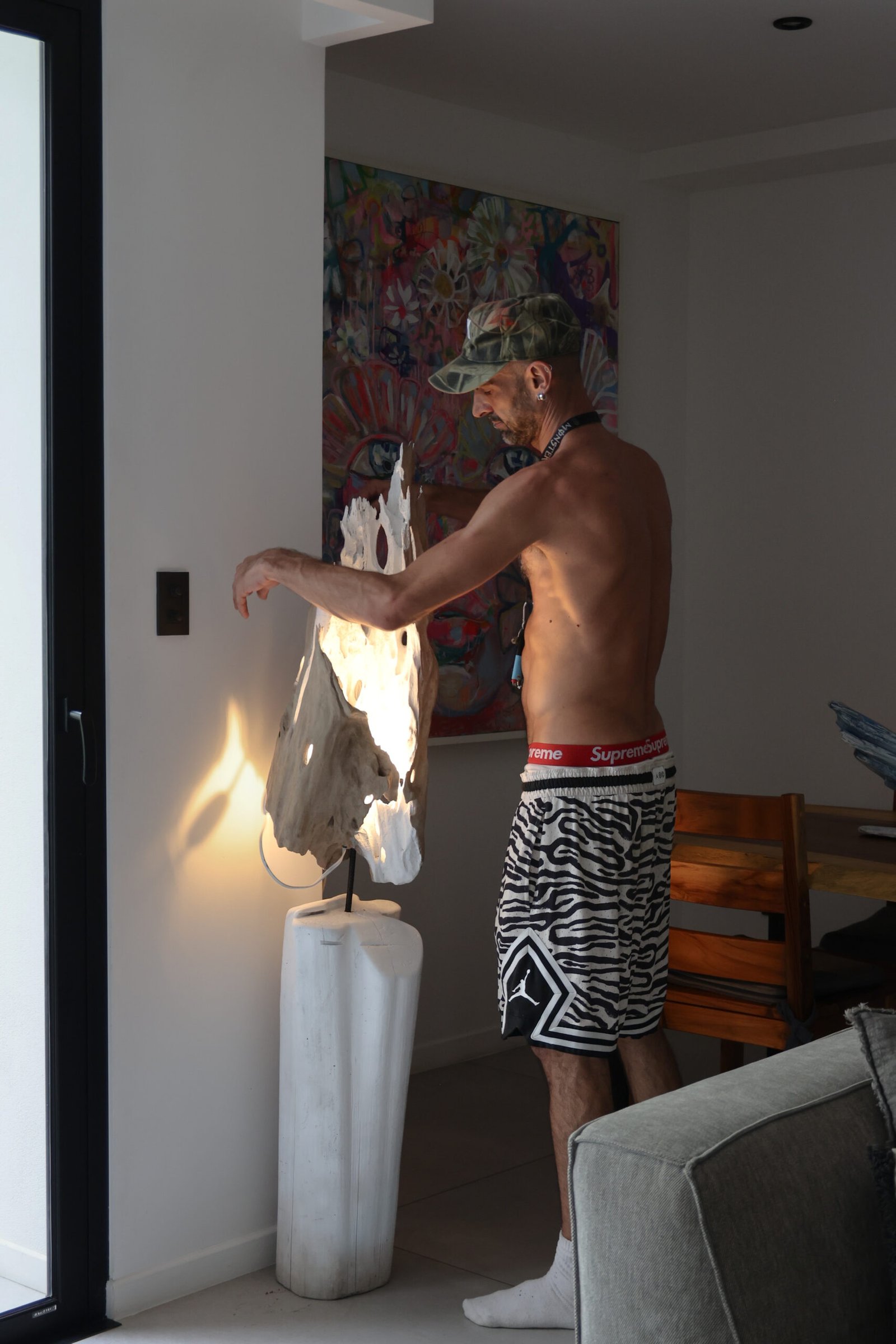
Pierre-Yves Labey — studio, Santa Teresa, 2026.
I grew up in France drawing objects and taking them apart, which is a reasonable description of industrial design as a career. The Master’s gave me the engineering; the houses gave me the standard. For twenty years I made accessories and leather goods in Paris — women’s runway pieces at Louis Vuitton under Marc Jacobs, accessories at Balenciaga under Nicolas Ghesquière and then Demna, and finally men’s leather goods at Hermès as Creative Director of the category.
That work is invisible in a specific way: your name is not on it, and the object has to be flawless anyway. I learned material there — how a hide behaves, how a finish ages, how much of a design lives in the last half-millimetre. I also learned how to hold a collection in my head and how to argue with a workshop respectfully.
Then Covid stopped the calendar. My wife and I had been visiting Costa Rica for years; in 2021 we moved for good, to Guanacaste. I bought a dark, closed 1990s villa and rebuilt it into Villa Pi.Casa, which is where the second half of this story starts — because to rebuild it I had to design at 1:1, in a climate that argues back, with whatever material was actually available.
What I found on the beach ended the transition. Driftwood: structures the ocean had already spent a decade making, free, everywhere, and impossible to buy twice. I began cutting, joining and lacquering them, and the same instincts that shaped a bag turned out to work on a two-metre trunk. Sculpture led to lamps, lamps led back to painting and drawing, and the houses of other people led to the remodeling practice.
Pedigree in numbers
The short version
20+
3
Creative Director
2021
Based in Santa Teresa, Costa Rica. One villa rebuilt, and a studio practice in reclaimed wood.
Path
Houses, roles and years
Training
Louis Vuitton
Balenciaga
Hermès
Pierre Yves Lab, Costa Rica
Relocated to Costa Rica after Covid. Designed, built and decorated Villa Pi.Casa, then shifted the practice to sculpture, lamps, painting and drawing — plus interiors for other people’s houses.
Philosophy
Four things I actually believe
Material has already decided most of it
Restraint is a luxury discipline
Function keeps art honest
Sustainability is a method, not a claim
“In Paris I made objects that had to be perfect. Here I make objects that have to be true — and true takes longer.”
Work together